
El Dorado Parole vs Probation
Parole and probation are often used as if they mean the same thing. In El Dorado County, the distinction matters because the supervising agency changes. Formal probation is a court-ordered local sentence or local supervision term handled by the El Dorado County Probation Department. State parole follows a California prison term and is handled by the California Department of Corrections and Rehabilitation, Division of Adult Parole Operations. Postrelease community supervision, or PRCS, is different again: CDCR releases the person from state prison, then the county supervises under the PRCS framework.
The El Dorado Probation FAQ defines formal probation as supervision in the community instead of, or after, a jail term. It also states a key public limit: the department generally cannot disclose where a probationer is or give status details to the public. That means a supervision check is not the same as typing a name into a public roster. A requester usually must work from a court order, a release record, a CDCR record, or direct agency contact where the agency can lawfully respond.
| Supervision type | Who handles it | Best verification route |
|---|---|---|
| Formal probation | El Dorado County Probation | El Dorado Superior Court case record, probation office contact, or the person's own paperwork |
| PRCS | County supervision after CDCR discharge to PRCS | CDCR PRCS materials, release paperwork, and El Dorado Probation contact |
| State parole | CDCR Division of Adult Parole Operations | CDCR records, assigned parole agent route, BPH schedule or results when parole hearings apply |
- Parole
- State supervision after release from California prison, normally tied to a CDCR case and a parole agent.
- Probation
- Local supervision ordered by the court, often tied to a county jail sentence or a sentence served in the community.
- PRCS
- Postrelease community supervision after a CDCR release where CDCR jurisdiction ends and county supervision begins.
- Discharge
- The end of a custody or supervision term for the agency named in the record.
Verify El Dorado Supervision
A useful El Dorado County parole and probation check starts with the release path. If the person left the Placerville Jail or South Lake Tahoe Jail after a local case, the court and probation path is more likely. If the person was sentenced to state prison, the CDCR path controls the prison record, parole dates, parole hearing history, and possible release to state parole or PRCS. If the person only disappeared from the current jail roster, that alone does not show which path applies.
- Search the local release path first. Use the county release record and court case record to see whether the person left jail by bond, time served, probation order, transfer, or another court action.
- Check the El Dorado Superior Court public portal for case events that may show sentence, probation, dismissal, remand, or transfer terms.
- For a state prison sentence, search CDCR CIRIS by CDCR number or name and compare commitment county, location, admission date, and parole-related fields.
- For PRCS, read the CDCR release material and then route local questions to the El Dorado County Probation office, knowing that public disclosure is limited.
- For state parole, use the parole agent route described by CDCR and check the Board of Parole Hearings schedule when a parole suitability process is involved.
The El Dorado County released inmates search path is useful when the first question is whether the person left county custody. Once supervision becomes the issue, the records must be read by agency. County probation, PRCS, and state parole can overlap in plain speech, but they are not the same legal channel.
Note: A public web result may confirm custody history without revealing current supervision details.
El Dorado Probation Offices
El Dorado County has two probation office points that matter for adult supervision geography. The county lists a Shingle Springs office and a South Lake Tahoe office, both with weekday office hours. These offices are not a public probationer locator. They are the correct local agency contacts when a court order, release paperwork, or PRCS material points to El Dorado County supervision.
The Probation contacts page is the best source for the office locations and current numbers. It should be used before relying on an old address from a case file, because supervision office routing can depend on residence, case type, or court instructions.
El Dorado County Probation, Shingle Springs
3974 Durock Road, Suite 205
Shingle Springs, CA 95682
Phone: (530) 621-5625
Hours: 8 AM to 5 PM
El Dorado County Probation, South Lake Tahoe
1360 Johnson Blvd., Suite 102
South Lake Tahoe, CA 96150
Phone: (530) 573-3083
Hours: 8 AM to 5 PM
The El Dorado County Probation contacts page also lists fax numbers and department leadership contacts. Use that page for current office details before sending records or appearing in person.
CDCR Parole and PRCS
CDCR materials are central when the release started in state prison. The CDCR sentencing and release page explains that a person completing a prison term may be released to state parole or to county-level PRCS. The PRCS page says a person released to PRCS is discharged from CDCR and is no longer under CDCR jurisdiction, while the county receives the supervision role. That sentence is easy to miss, but it changes where a verification request should go.
The manifest screenshot comes from the CDCR PRCS explanation, which is the state-level source for PRCS terms, county notice workflows, and change-of-status language.
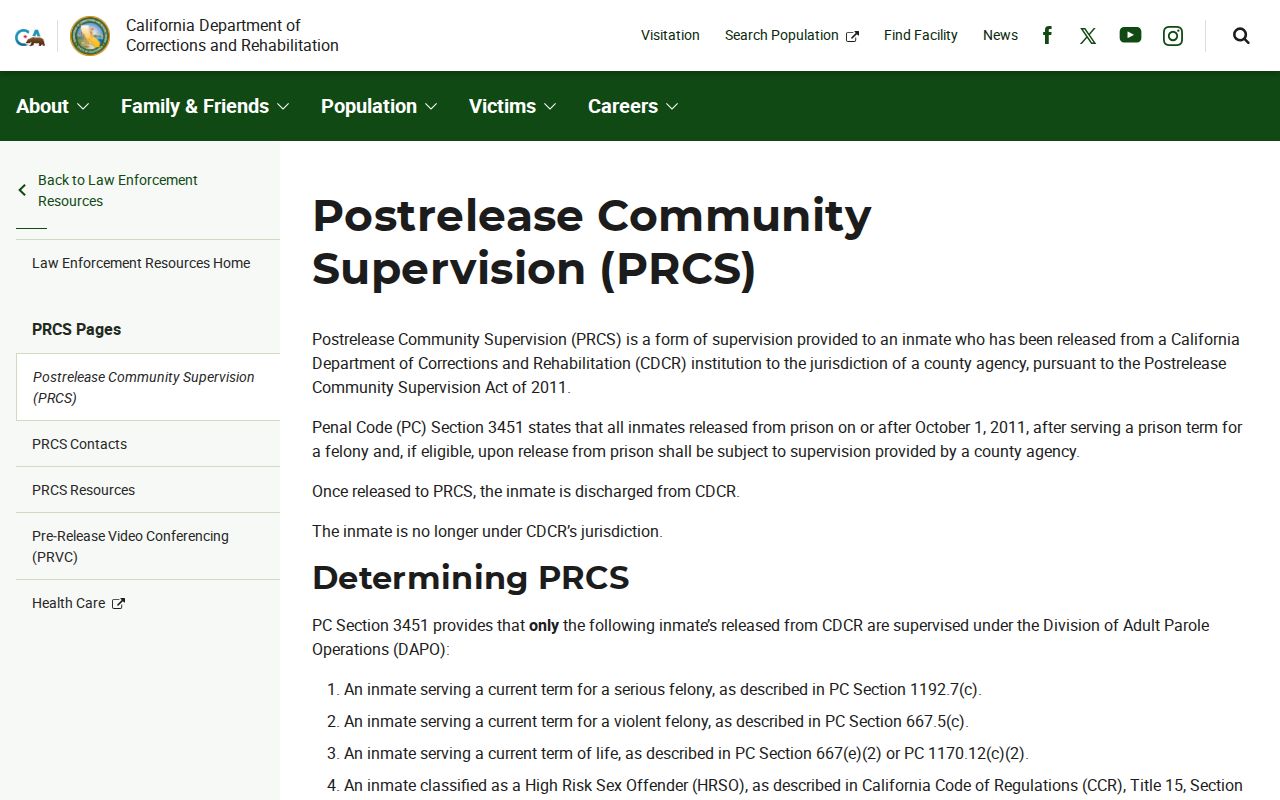
That CDCR source helps separate a prison discharge to PRCS from ordinary county probation and from state parole under the Division of Adult Parole Operations.
State parole verification is different. CDCR's parole assistance material points to the assigned parole agent as the route for parole information. The Board of Parole Hearings, or BPH, becomes relevant when a person has a parole suitability hearing or a parole eligible date rather than a simple county jail release. The BPH hearing schedule includes hearing dates, location or video information, and links to results and population search tools.
El Dorado Parole Hearings
Parole hearings do not confirm a same-day release from the El Dorado County jail. They are state-prison events. They matter when an El Dorado Superior Court case led to CDCR custody and the person is moving through parole eligibility or a suitability hearing. BPH identifies date labels such as EPRD, MEPD, NPED, YPED, EPED, and the controlling parole eligible date. Those labels are part of the state prison record, not the county jail roster.
BPH hearing results can also be less final than they first appear. CDCR materials say hearing panel decisions are proposed and usually become final within 120 days after legal review. A tie can go to the full Board. Some grants are subject to Governor review, and some people with a grant may still have another sentence, a minimum date, or another legal barrier before release. For an El Dorado County supervision check, treat a parole hearing result as one state-prison milestone, then verify the actual release or supervision agency separately.
El Dorado Absconder Limits
An absconder is a person accused of failing to report or leaving supervision without permission. A warrant can follow, but the public path in El Dorado County is limited. The research found no county-published adult absconder list. CitizenRIMS configuration also has warrants disabled. The Sheriff's Records page says warrants are not confirmed to the public over the phone.
That does not mean warrant status is unimportant. It means there is no reliable public El Dorado County absconder list to search. A person may appear at the Sheriff's Office, jail, or Records Unit with current photo ID and ask for a warrant check for themselves, or contact the local court. If supervision status is tied to a court case, the court record may show a violation filing, recall, remand, or new order before any public roster changes.
Important: Do not treat the absence of a public warrant result as proof that no warrant, hold, or violation exists.
Release Property and Reentry
El Dorado County release work often includes practical steps beyond supervision status. The Sheriff's Property Unit page says property services require an appointment, acceptable ID includes California ID, California driver's license, or military ID, and a property release request may take up to two weeks depending on case type. Placerville property is handled at 200 Industrial Drive, while South Lake Tahoe property is handled at 1360 Johnson Blvd. by appointment.
The Sheriff's Inmate Services page also documents local in-custody programs such as adult education, GED or diploma work, HEARTS substance-use education and personal development, religious services, AA/NA, parenting classes, Moral Recognition Therapy, and anger management. These programs should be described as transition supports inside custody. They do not prove that a person is on probation, parole, or PRCS after release.
El Dorado Supervision Discharge
Supervision ends through the agency that controls it. A county probation term may end through the court and probation process. A PRCS term is a county-supervised status after CDCR discharge to PRCS. State parole ends through CDCR parole procedures. The release record, court disposition, and agency discharge paperwork should be read together because each may answer a different question.
A discharge from one agency is not always the end of every legal duty. A person may be done with county jail custody but still report to probation, done with CDCR custody but under PRCS, or done with a parole hearing process but waiting on final review. The most precise wording is agency-specific: released from El Dorado County jail, discharged from CDCR to PRCS, on CDCR state parole, or discharged from supervision.