
Projected vs Actual Release
A projected release date is a calculated or scheduled date. It is not the same as the moment a person actually walks out of custody. In El Dorado County jail cases, the projected date can depend on the court sentence, actual time in custody, conduct or work credits, holds, and jail processing. In state prison cases, CDCR and the Board of Parole Hearings use specific date labels that can point to a release date or a parole eligibility event.
A pretrial detainee is different. A person awaiting case resolution does not have a sentence-based projected release date. Release may occur through bond, own-recognizance order, dismissal, time-served disposition, a court order, or transfer. The public current-custody roster can show that a person is in jail, but it does not calculate a final release date for every person listed.
Important: A scheduled date can change before actual release because credits, holds, discipline, court orders, or parole review can change the legal path.
Find El Dorado Projected Date
The best lookup route starts with the agency that has custody. El Dorado County has two adult county jails, the Placerville Jail and the South Lake Tahoe Jail. A person sentenced to California state prison is no longer tracked by the county jail as the main custody system. A person in federal or immigration custody has a separate federal or ICE path.
- Search the county current-custody roster first only to see whether the person is still held in the El Dorado County jail system.
- For a county jail sentence, check the El Dorado Superior Court case record for sentence terms, custody credits, minute orders, and any release-related order.
- Contact the Sheriff's Records Unit or custody channel for public booking and release details when the person has left the roster.
- For a state prison sentence, search CDCR CIRIS by CDCR number or name and compare commitment county and admission details.
- Use VINELink Check for custody-change alerts, then confirm final release with the agency record.
The El Dorado County released inmates page covers the broader release-record path. For date work, the court order and custody agency record matter most because they explain the sentence and credit basis.
El Dorado Jail Date Credits
County jail release computation begins with the court and jail record. Penal Code section 2900.5 requires the sentencing court to determine admission and release dates before sentencing and total days credited to the term when the custody relates to the same conduct. The total credited days must appear in the abstract of judgment. That makes the court record a durable source for why a time-served or credit-based release happened.
County conduct credits are harder to summarize. Penal Code section 4019 has changed over time, and the California Courts custody-credit memo notes that formulas vary by offense date, sentence date, custody type, and exclusions. The safe rule for an El Dorado County projected release date is not to use a universal half-time formula. Use the sentence, custody-credit calculation, offense category, holds, and jail administration record.
| County date input | Why it matters |
|---|---|
| Court sentence | Sets the jail term or probation condition that creates the custody period. |
| Actual custody days | Counts days already served and can affect time-served release. |
| Conduct or work credits | May reduce the remaining local custody term when legally available. |
| Holds or detainers | Can prevent release from all custody even when the local sentence ends. |
| New court order | Can amend, recall, remand, release, or transfer the person. |
CDCR Release Date Labels
State prison date work belongs to CDCR and BPH. CIRIS is the official California Incarcerated Records and Information Search. Its field description includes name, CDCR number, age, current location, commitment counties, admission date, and Board of Parole Hearing dates and outcomes. The state materials also identify a Parole Eligible Date label and the controlling parole eligible date.
The manifest screenshot comes from Penal Code section 2933, the California prison worktime-credit statute that helps shape state projected release calculations.
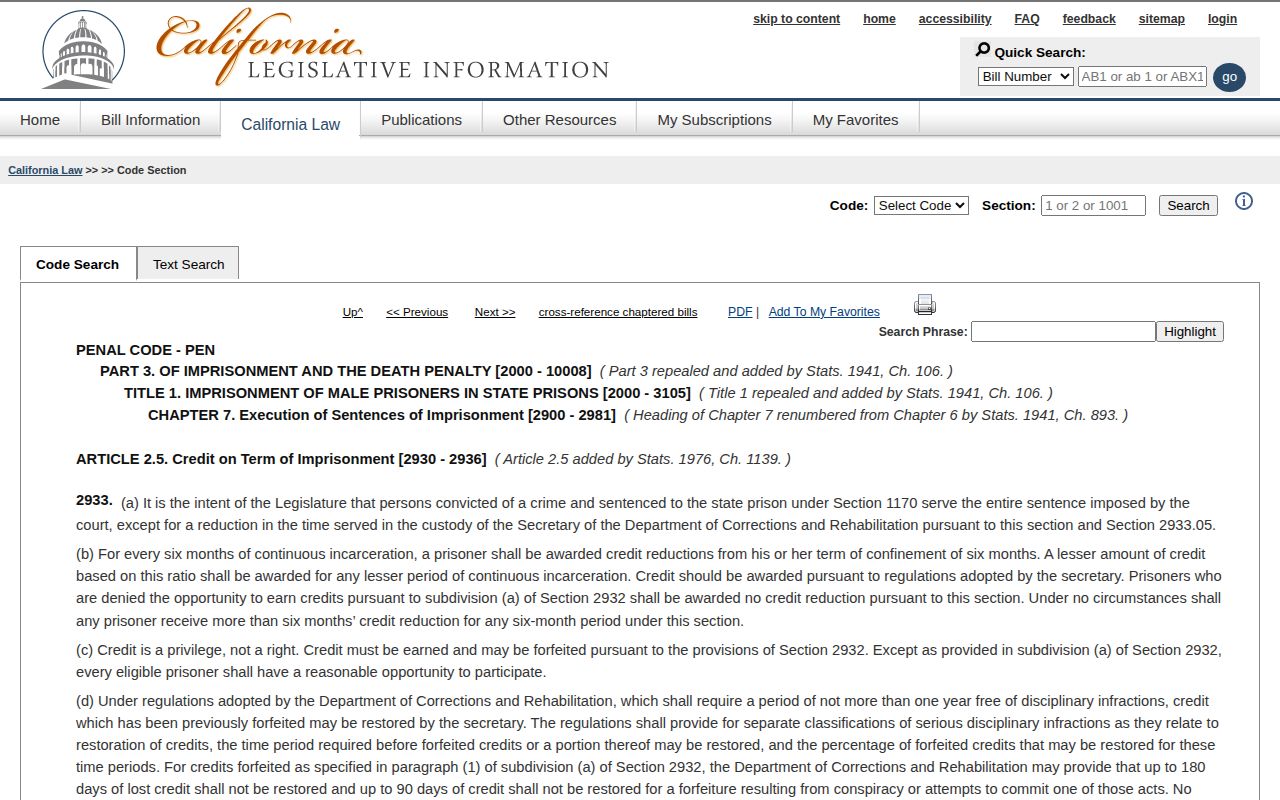
The statute image fits the state-prison side of the page because CDCR release dates can turn on earned credits that are gained, lost, or restored under state rules.
| CDCR or BPH label | Meaning |
|---|---|
| EPRD | Earliest Possible Release Date for many determinate sentences after credits. |
| MEPD | Minimum Eligible Parole Date for life-with-parole sentences. |
| NPED | Nonviolent Parole Eligible Date under Proposition 57 for qualifying people. |
| YPED | Youth Parole Eligible Date for qualifying youth-offender parole review. |
| EPED | Elderly Parole Eligible Date for qualifying elderly parole review. |
| Controlling date | The earliest applicable date that controls the opportunity for release or parole consideration. |
California Good-Time Rules
Penal Code section 2933 is the basic state-prison worktime-credit statute cited in the research. It states that eligible prisoners may receive credit reductions for continuous incarceration and that credit is a privilege, not a right. It also allows credit to be forfeited and restored under rules. That is why a projected state release date may move after discipline or credit review.
Penal Code section 2933.1 supplies the violent-felony credit cap. It limits worktime credit to 15 percent for people convicted of listed violent felonies, and the same cap applies to specified presentence county jail confinement before CDCR custody. This is often described as an 85 percent rule, but it is not a universal rule for every California inmate. It applies to the listed offense category.
State prison credits and county jail credits should not be mixed. A county jail sentence may use Penal Code section 4019 and court-calculated custody credits. A CDCR sentence uses CDCR and BPH labels, prison credit rules, and parole hearing law where applicable.
Why El Dorado Dates Change
A projected release date is vulnerable to later facts. Some changes help the date move earlier. Others move it later or stop release from one agency from becoming release from all custody. A person can satisfy an El Dorado County jail sentence and still be held for a warrant, transfer, state prison commitment, or another legal process.
| Change factor | Possible effect |
|---|---|
| Credits earned | May reduce a sentence-based release date when allowed by law. |
| Credits lost or restored | Can move a state prison date later or earlier after discipline review. |
| Recent admission or transfer | Can cause data lag before CIRIS or other systems show full details. |
| Amended court order | Can change custody credits, sentence length, or release instructions. |
| Detainer or hold | Can keep a person in custody after one sentence or agency term ends. |
| BPH or Governor review | Can delay or change release after a parole suitability decision. |
Note: A date on a public system is a starting point, not a promise of physical release at that exact time.
El Dorado Court Records
The El Dorado Superior Court record can explain the release-date math better than the jail roster. The court's Online Services page offers Case Index search by name, case number, or filing date. The public portal covers criminal, civil, traffic, and family matters, but it warns that portal data is not the official record and may not include the latest filings.
For a date question, search for the sentence, minute order, custody-credit entry, abstract of judgment, dismissal, warrant recall, remand, or transfer order. If the person was sentenced to state prison from El Dorado County, the court record explains the commitment while CDCR explains the prison custody status. If the person was released from jail after local sentencing, the court record may show why the release occurred before the public roster changed.
Bond and bail entries also matter. A bond release does not mean the sentence is complete, and a case can continue after the person leaves jail. A time-served or credit-based release has a different record trail because the court has applied custody days to the sentence. Reading the court event first helps keep those release types separate.
Confirm El Dorado Release Date
Final confirmation should come from the agency with custody or the court order that controls the custody term. For county jail custody, use the Sheriff's Records Unit, jail custody information, and the court case. For state prison custody, use CDCR CIRIS, BPH hearing material where relevant, and any parole or PRCS paperwork. For alerts, use California VINE, but treat the alert as a prompt to verify.
When asking for a record, use precise wording. Request the public booking and release information, including booking date, release date or time if disclosable, time and manner of release under Government Code section 7923.610, booking number if available, charges or holds, and whether the person was released or transferred. That language fits the California public-records hook without assuming the outcome.
Parole Hearing Date Effects
For some CDCR prisoners, the release-date question is not a simple countdown. The Board of Parole Hearings schedule can show hearing date, time, location, and whether the hearing will be in person or by video. The research notes that schedules are updated weekly on Thursday morning and that BPH links hearing results and CIRIS. Those hearing records matter when an El Dorado County conviction led to an indeterminate sentence or another parole-review path.
A grant at a parole hearing may still need review. BPH materials explain that hearing-panel decisions are proposed and generally become final within 120 days after transcript and legal review. Some decisions can be referred to the full Board, vacated, or sent for another hearing. Governor review can also affect final grants in specified cases. For a projected release date, that means a hearing result can be important without being the same thing as an immediate release from prison.
No Fixed Date Cases
Many El Dorado County jail searches do not have a projected release date at all. A person held before trial may be waiting on bail, arraignment, a hearing, a hold, or a court order. A person held on a probation or PRCS sanction may have a different custody clock than a person serving a straight jail sentence. A person held for another agency may leave El Dorado custody only to enter that other agency's process.
In those cases, the useful question changes from calculation to verification. Check current custody, court calendar and disposition, holds, bail or bond status, and records-request options. If the person is not listed in current custody, ask whether they were released from the county, transferred to CDCR, moved to another county, taken on a federal or immigration hold, or released with supervision instructions. That approach avoids a false date when the sources do not support one.